



Risk is what a buyer stands to lose by ignoring their pain, and it is what makes acting urgent. We measure it with the PIP Risk Matrix, which scores each risk out of five on Propensity (how likely it is), Impact (how severe it would be) and Proximity (how soon it would hit). A risk that does not score 10 or more out of 15 is unlikely to move a buyer to act.
So, we’ve looked at Pain; and Pain is the first element of a three-phase journey that enables us to describe just how critical it is for our prospect to act, and to act with urgency.
This brings us to the second phase – Risk.
Often our prospects have not fully articulated this Risk, because:
Risk is the implication of something negative occurring to something we value.
Think about a persistent headache. Most of us take a painkiller and get on with our day. However, I noticed his behavior was becoming markedly different, and we were getting comments about his attitude. After insistence from the team that he see his GP and after some tests it turned out he actually had cancer.
The headache was the Pain, cancer was one of a number of Risks, and unfortunately on this occasion it was a Risk which came to pass. But, because it was spotted quickly, the consequences were not as serious as they could have been.
In order to show a B2B buyer why their Pain must be prioritized we have to be able to articulate the Risk. When we discussed Pain I recommended you run an exercise to isolate which Pains for your customers are the most serious; then I gave you a measurement framework for grading the severity, The Hierarchy of Pain. Now, those Pains will ladder up to Risk. It might be one Risk per Pain or that all your Pains ladder up toward one specific Risk, this is something you’ll soon be able to visualize and articulate.
We have developed our own model, which we call the PIP Risk Matrix. The Matrix is a model for assessing and scoring the three factors which contribute to Risk severity. All scores are out of five.
The first P stands for Propensity: How likely is this to happen?
Of course, two people can easily disagree over Risk Propensity - but that’s the beauty of a scoring system. If I score the Risk at 3, and you score it at 4, via our debate we are forced to justify our reasoning, making our final decision sharper and more focused.
However, Propensity alone isn’t enough.
This is why we need to assess Impact; the I. For this, I borrowed the US meteorological system for assessing hurricane strength. 5 out of 5, being the most extreme, means company death or loss of a job. See below for the complete scoring system.
The second P and third measurement is Proximity. This matters a lot. I spoke in a video about climate change. One of the biggest reasons why people, even governments in the Global North, fail to act; is because it seems so far off. It won’t affect me personally. Far off Risks are nevertheless Risks - but it doesn’t mean we shouldn’t prepare for them.
| Score | Propensity | Impact | Proximity |
|---|---|---|---|
| 5 | certain | catastrophic | Immediate - Within the month |
| 4 | probable | extreme | Near term - Within the next 3 - 6 months |
| 3 | likely | extensive | Mid term - Within the next 6 months - 1 year |
| 2 | possible | moderate | Far term - Within the next 1 - 3 years |
| 1 | unlikely | minimal | Long term - Within the next 3 - 5 years |
Once you have all three scores, you can plot your Risk on a chart using all 3 dimensions. As you can see, a large node plotted in the top right hand corner expresses the most serious Risk.
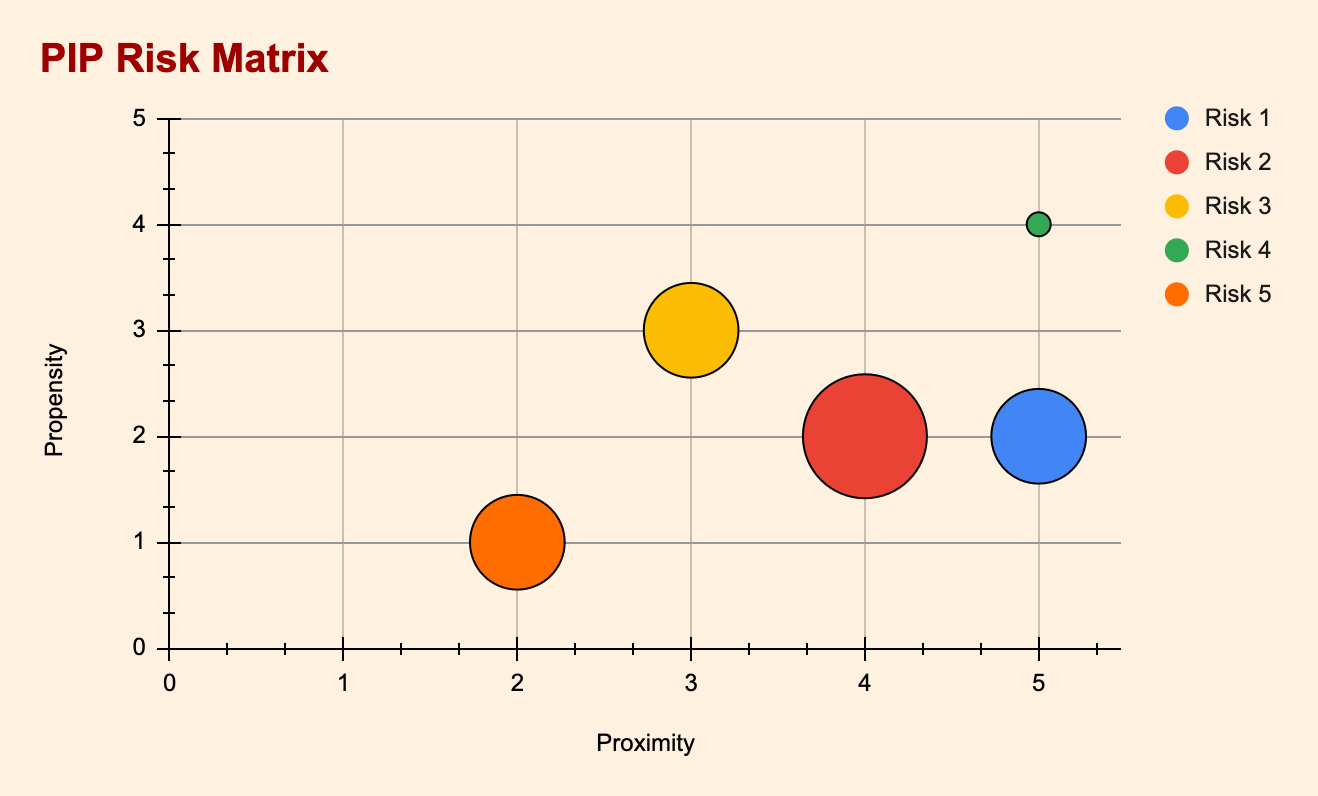
Pro tip: If your Risk isn’t justifiably scoring 10 or more in total out of 15, it is unlikely that it is a Risk that will cause action. You may need to score even more than this.
Real world example: If I bet my entire life savings on the result of a horse race there is a Probable Risk that I will be wrong - that’s 4 out of 5; it’s also an Immediate Risk. So that’s 5 out of 5 on this measure. It will also have a devastating Impact. However, if I only bet $10 the Impact will be Minimal - that’s a 1 out of 5 score, and therefore probably not a Risk that gives much cause for concern. In other words, all 3 dimensions need to be considered for a Risk to be truly understood.
Another example: Kluster is a forecasting layer that sits across the top of your CRM.
The Core Pain: “My forecast is frequently wrong, I look like an idiot in front of the CEO”.
Pro tip: And remember my notes on the importance of having the contextual understanding of your customers’ Pain to really let the Risk take root. So in this case it would be:
The Risk: “I can’t speak for other revenue leaders, but I know for me, if I get my forecast significantly wrong more than once, I will lose the faith of the CEO. She will then lose the faith of the Board. The average tenure of sales leaders is only 18 months; failing to predict the future accurately is a major driver of sales leaders' tenures ending abruptly”.
But the Risk can still go even deeper than this: “If the CEO is losing the faith of the Board, then fundraising will be harder. How can anyone believe we will make a future quarter until we have proven it? This puts the future of the company at risk. Now we have to ask if we have sufficient runway to achieve our goals”.
How we create the message for this to resonate with customers, will come later. So don’t worry about that immediately. Now, how should we score this example?
The score: The majority of revenue leaders in scale-up land get their forecasting wrong, so it’s probably a (3), quite possibly higher. The Impact, however, is clearly Catastrophic (5) if it continues, and two quarters will pass in just six months, so it’s Near Term (4). So just on a first pass it’s a score of 12, and Kluster may well argue in their messaging that it’s even stronger than this.
Consider the Pains you analyzed last time. Grab your post-its again and scribble down the Risks that result from failing to act on the Pains. Think up as many as you can, but don’t worry if your Pains lead toward the same Risk, that’s not uncommon. You may have one Risk, you may have more than one.
Now score your Risks using the PIP Risk Matrix. Discuss with your co-workers & figure out if you agree on the scoring. Now rank them.
If you sell to multiple Casualties (Personas) you may find that the Risks are different inside the same ICP Prospect. We’ll discuss Casualties and their varying levels in more detail in an upcoming deepdive.
Now you can articulate the Pain experienced by your prospect, and can lead them to understand the Risk of failing to act on that Pain. In the next article we look at the third and final phase: the Strategic Driver. If you want to know how serious the Risks in your own business are, email pete@revelesco.com and we'll talk it through.
See everything in Insights.
Tell us what is happening with your revenue, and talk it through with Pete or Emily.

[ Revenue insights ]
Concise and digestible. Revenue deep-dive analysis for B2B SaaS CEOs, Founders & Revenue leaders.


Design by V. Bakhal


