


In Part II of our own case study, we turn the pain, risks and critical problem from Part I into a value proposition. List your components (features, benefits, partnerships and services), combine them into value stacks, and score each stack on Criticality, Rarity and Immunity until three remain. Then choose a category strategy, turn each stack into a messaging pillar, and turn the Critical Problem into a Core Insight. Our pillars today are Framework Driven, Relentless Focus and Predictable Growth, and Whole Revenue Strategy is the category we are creating.
Editor’s note: We wrote this in 2024. Our positioning has moved on since then. Our three phases are now Diagnose & Align, Design & Build, and Grow & Scale, and our Messaging Pillars are Framework Driven, Relentless Focus and Predictable Growth. We’ve kept this piece because the method still holds.
In Part I, in a fit of radical transparency, I ran through the first half of the thinking behind Revelesco’s positioning. The goal was to bring the Criticality & Rarity Framework to life. For those of you that missed it, you can read it here. Now for Part II.
You will recall that Emily & I had a perception problem. More about The Perception Matrix can be found here but in a nutshell, how we viewed ourselves, and how our ICP viewed us were not the same. We were perceived as coaches, which is of course correct (and we continue to provide coaching), but we were rarely perceived as strategic advisors, capable of leading a serious SaaS business through a Whole Revenue Strategy motion, starting with triage and ending in extraordinary outcomes - growth, velocity, and ultimately significant, rising & sustainable ARR.
This needed to change if we were going to run more of these projects and achieve our vision: that founders & CEOs would be capable of successful scale. Avoiding the mistakes of those that went before.
In Part One I covered the first half of Revelesco’s Criticality & Rarity Matrix: the Pain experienced by the Casualty (the CEO) at our ICP (purpose-driven B2B SaaS businesses with $10M to $50M ARR), the Risks of failing to act on those Pains, and other essential factors such as the Storms, the Driver and the Critical Problem. You can access the supporting spreadsheet here.
In Part Two we are going to convert the insights uncovered in Part I into communicable Value, starting with Components.
Like everything that requires construction, we must start with the building materials. Components are the building blocks which, when stacked together correctly, construct the completed building. In our case we are stacking together the Components of Value. But before we can stack them, we need to identify the Components we have at our disposal. There are four types:
This is the one area where I imagine Revelesco differs from most SaaS businesses. We are not offering software. Nevertheless we have Components that fall into each of these groups. There isn’t space to list them all, but here are a few examples:
Features - Our custom frameworks. There are many, including the one you are working through now - the Criticality & Rarity Framework.
Benefits - Our combined years of experience means there are very few situations that at least one of us hasn’t encountered previously. The sum is greater than the parts.
Partnerships - Our networks. Accessing us means accessing our friends, ex-colleagues & peers. Some of our contacts work at your prospects or customers, others can provide elite ancillary services that we cannot, such as head hunting.
Services - Our expertise: I could take any of the team here, but let’s take Karen - you don’t run marketing at Apple, Marketo & LeanData if you’re substandard!
The exercise here is simply to list everything out - your post-its may easily run into the hundreds.
Stacking up the Value is the next step. If you have all the post-its on a white board or online equivalent, you’re now going to start combining them; or Stacking them. This is because very few of your Components will deliver Mission Criticality & Rarity in their own right. But when placed into combinations with other Components you will start to build a battle force that is hard, ideally impossible, to conquer.
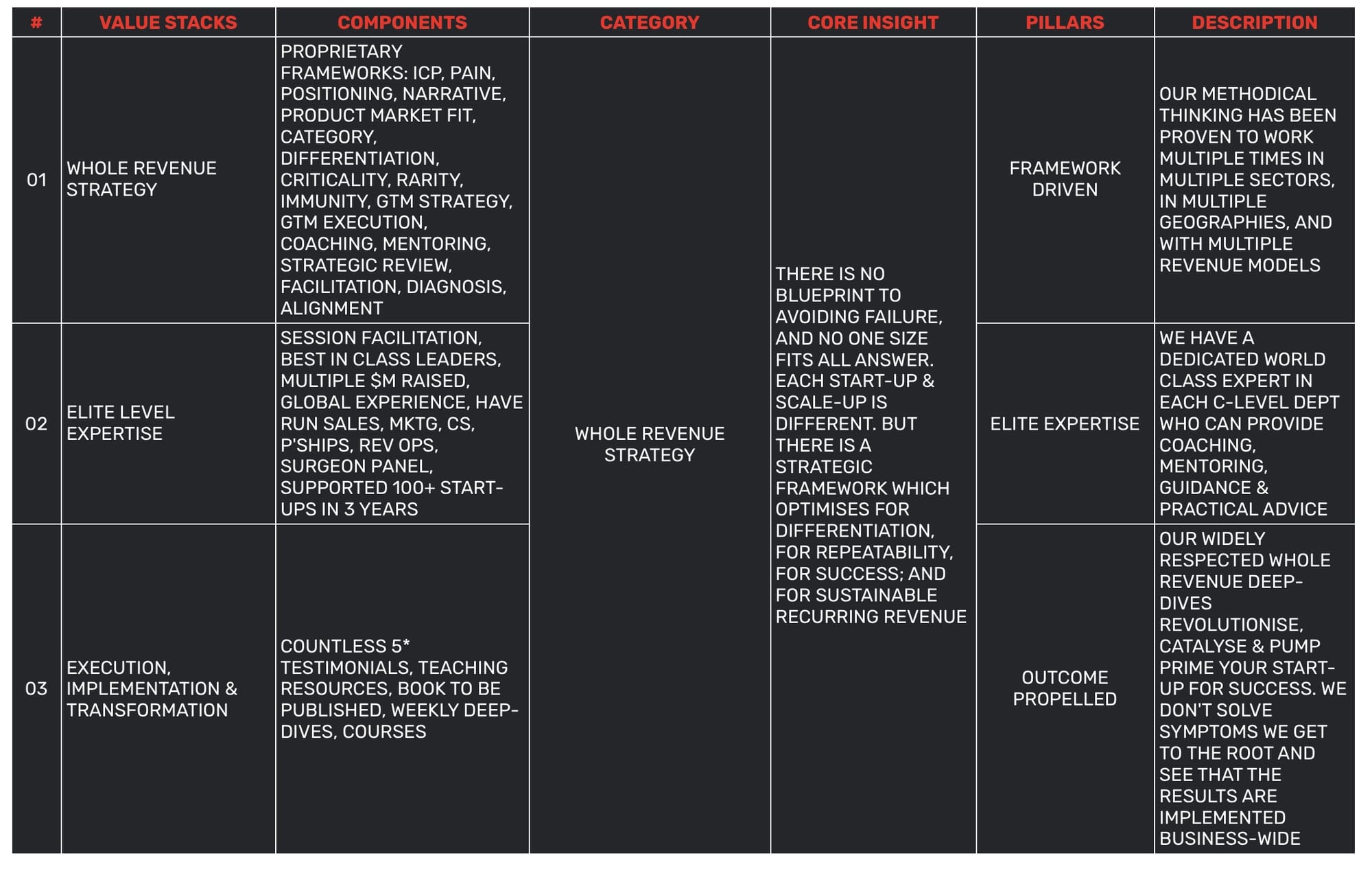
We built seven different Value Stacks in total - you may end up with more. Don’t worry if some Components feature in more than one Stack.
Next you’re going to score each Stack against 3 criteria - Criticality, Rarity, and Immunity. In other words, how essential is this Stack to your ICP, how unusual or even unique is the way that you do it. And finally how far does it create a barrier to success for your competition. The goal is to decide on just three Stacks. Three is more than enough to focus on for most startups.
For Revelesco, we hit on the following Value Stacks, labeled as follows:
Whole Revenue Strategy: More on this label in a moment. In the meantime, this Value Stack contains all of our proven frameworks covering topics such as positioning, narrative, differentiation, & GTM Design amongst many others. Each Component is useful. Combined they become a powerful mesh, far greater than they could ever be alone.
Elite Expertise: This Stack wraps up the combined experience of the twelve members of the Revenue Surgery, the Surgery itself, the $Ms ARR they have delivered, and the $Ms of funding raised.
Execution, Implementation, Transformation: So many advisors talk a good talk. The final Stack demonstrates our focus on delivery and can be summarized as Social Proof. This wraps in testimonials, the countless recommendations, the people who have taken our courses, the book to be published. When you add that up across 12 people its breadth & depth becomes almost unassailable evidence of the capability to Transform. It’s not just frameworks and experts, we actually deliver.
Category is a controversial subject. The best thinkers on this subject disagree entirely on its centrality to getting positioning right. Category Pirates for example will tell you that nothing is more important than creating a Category. April Dunford on the other hand argues that very few businesses ever create a Category, and it doesn’t hold them back from creating extraordinary Value.
My own view is that what’s most important is to choose one of the four category strategies: Creation, Adoption, Redefinition, or Disruption. I have written two articles on this topic which you can access here and here.
When we first wrote this, we chose the third strategy: Redefinition. We have since gone further. Whole Revenue Strategy is the category we are creating and defining: the kind of rigor the big firms bring to enterprises with $500M+ revenue, applied to SaaS companies with $10M to $50M ARR.
Our established Category is probably best described as SaaS Consulting or maybe GTM Consulting. We have not ripped up the rule book and started from a new baseline which is what would be required to try & consign this Category to the scrap heap. That would require something utterly paradigm shifting such as an LLM/ AI model replacing human consulting. No doubt it will be a possibility in the future, but not just yet.
Neither are we joining (Adopting) the status quo. A new consultant starts up every day, there’s nothing wrong with that, but it is a very crowded space. Nor are we convinced in any case that the world needs yet another ex-VP Sales consultant.
We have chosen Redefinition and we re-define it like this:
Whole Revenue Strategy refuses to look at sales, marketing, customer success, or product in their own right. In fact it refuses to engage with traditional departments in general. After all, departments are just functions which help us deliver on our goals. Instead Whole Revenue Strategy looks at the four core drivers of Revenue success:
Desirability - We have built a product that solves a Pain.
Clarity - We can tell a story that explains this clearly.
Predictability - We can distribute this message at scale.
Deliverability - We always fulfil the promise we made.
The final strategy is Disruption. The key to understanding Disruption is that it tries to show that the way things are done today is wrong and a revolution is required; an entirely new way of acting. This is not our position at Revelesco. The Components of our Value Stacks are in themselves not revolutionary. We believe it is the way we have put them together and the emphasis we place on WRS which makes us so different. It is an evolution, not a revolution.
It is important to note that each of the four strategies is perfectly legitimate. What is most critical is that you make a choice and deliver on it. Fudging the lines confuses the market.
We are very aware that we are operating in a deeply entrenched Category, older than software itself. However our aim is to educate the market that success does not come from just engaging a consultant. It comes from the fundamental understanding that there is a right way, and a wrong way, and Whole Revenue Strategy is the right way to do this.
It means for example, that if someone in the industry asks us what we do - we reply that we are Whole Revenue Strategists. We want the market to adopt the phrase and use it as a proxy for the “right way” to deliver in our Category.
The Messaging Pillars are the vital link between strategy and action. This is where you take all of your thinking and bundle it up for the market. The goal is to articulate each of your three Value Stacks in a way which is clear & obvious for the Casualties at your ICP to understand. If they are to buy from us they will need a Criteria of Choice which they will use to evaluate us against the competition, even if that competition is just the status quo.
If our messaging is sufficiently clear & obvious they should take our Pillars and deploy them as their Criteria. It is very hard for competition to beat us if they are having to fight on our territory.
Sometimes your Messaging Pillars will be labeled precisely as your Value Stacks were. But that is not always the case.
Our first Pillar is a case in point. While we want the market to understand the Category term - Whole Revenue Strategy - we are aware that a term we have coined ourselves, will take time to be understood. Instead our first Pillar is:
Framework Driven - Our methodical thinking has been proven to work multiple times in multiple sectors, in multiple geographies, and with multiple revenue models.
Our second however is named directly after the Stack. We know we are not the only strong revenue thinkers in the world. But when you combine the quality of the team with the first Pillar i.e. an elite team with their own expertise but operating under the banner of WRS you start to see how it can be hard to compete with us:
Relentless Focus - An aligned, C-level team with the lived experience to give you a 360° view, so your whole business focuses on what really matters.
Finally our third Pillar takes the idea of Execution & Transformation from the Value Stack and converts it to:
Predictable Growth - We don’t solve symptoms. We get to the root cause, then build the performance architecture that lets your leaders deliver predictable, scalable, repeatable revenue.
How do we use this? You can read about this here. But in essence it means that everything we say publicly, must be part of one or more of these Pillars, whether it is a five word Google ad or a 2,000 word white paper.
The Core Insight is the final piece. It summarizes your Pillars and enables the market to correctly perceive your positioning. It elaborates on the Category by explaining precisely how the Category should be defined. Even if you have chosen to Adopt a Category, you will still need to explain your differentiation. Your Core Insight is your chance to do that.
Revelesco’s is this:
Growth is hard, but the alternative, not growing, is existential. Revelesco’s Whole Revenue Strategy is the only methodology that combines proven frameworks, aligned expertise and trust-driven performance architecture to deliver predictable, scalable, repeatable revenue.
The trick here is to imagine these two or three lines emblazoned across your website. The lines will be the inverse of your Critical Problem, and summarize your three Messaging Pillars articulately & clearly.
This is not an exercise to be run through quickly on a Sunday evening - it usually takes a couple of months to build this out properly. However it can be a useful exercise to quickly run through how you think your current value prop maps to the above. Building on Part I, you can sequence it like this:
Run back through this - can you imagine creating a demo, or an investor deck based on the three Messaging Pillars? Can you imagine your ICP prospects using the Pillars as their Criteria of Choice? If so, you might be onto something effective.
Thanks for reading. If you want to see how your own positioning stands up, email pete@revelesco.com and we'll talk it through.
See everything in Insights.
Tell us what is happening with your revenue, and talk it through with Pete or Emily.

[ Revenue insights ]
Concise and digestible. Revenue deep-dive analysis for B2B SaaS CEOs, Founders & Revenue leaders.


Design by V. Bakhal


