



Each of the four category strategies calls for its own demand and messaging approach. Category Creation needs demand generation and a message of Invention, because the market must first learn that the category exists. Adoption, Redefinition and Disruption all capture existing demand, with messages of Differentiation, Evolution and Revolution respectively. In our experience most start-ups have not thought this through, and the result is muddled messaging: which strategy you choose matters less than being clear about it and executing it deliberately.
Ever seen an otter? It’s in the “carnivorous animal” Category. Want to find a laptop in the department store? It’s going to be in the “personal electronics” department. Without this straightforward system of designation we would be lost. Categories are key to our understanding of the world and it’s no different in Revenue strategy. If you use Salesforce or Hubspot, you probably refer to it as your CRM – whether they like it or not, that’s the Category we have decided upon.

As SaaS leaders, getting Category right delivers context to our product or service. Our brains need this taxonomy in order to understand what we are dealing with. If we leave the market to its own devices it will either ignore us (result: we fail), or it will lump us into a Category that we may not like (result: potentially also failing).
My last operating role was at Ometria - from the very beginning the founders could see that the existing Category, ESPs (Email Service Providers), were old tech. The Category was moving toward commoditisation. Generally the successful companies in this Category won on price and sometimes the quality of their integrations or ability to handle large scale. The insight that led to the creation of Ometria was that there was an entirely new way to solve the Pain of generating income from the delivery of messaging at scale. Ometria calls itself a CDXP (Customer Data Experience Platform), an entirely new beast.
If that effort had not happened, chances are we would have been lumped in with the ESPs, where we would have:
a) Been lost among some huge players
b) Been forced to compete on price.
Positioning ourselves as a CDXP mitigated both these concerns, but also informed the market that there was an entirely new way of doing things. Being deliberate about Category is an essential part of Whole Revenue Strategy. We take our own advice here: Whole Revenue Strategy is a category we are creating.
The previous article examined the four contrasting Category Strategies - easily memorizable with the mnemonic, CARD:
For a quick reminder of the detail, jump here for a recap.
What we didn’t yet touch on is the impact that each of these four strategies have on your Revenue Strategy. Whole books can (and have) been written on each of these - so treat the below as an introduction highlighting the critical stuff you need to know and we will come back to each of them in more detail in the future.
When it comes to the market, it’s much like a game of chess, there are many ways to attack; including many new methods we won’t have seen before. However, like the game, there are some basics to master and that’s what the matrix below outlines.
If you are re-defining a Category, your go-to demand strategy is Capture rather than Generation i.e. the market already exists, and has established demand. Your job is to orient the demand to your Capture points i.e. landing page, event etc.; and you will primarily do that through a Message of an evolving Category. i.e. “The market is changing, the old Category is no longer capable of healing the Pain. Our product is designed with that change in mind. Get left behind at your peril”.
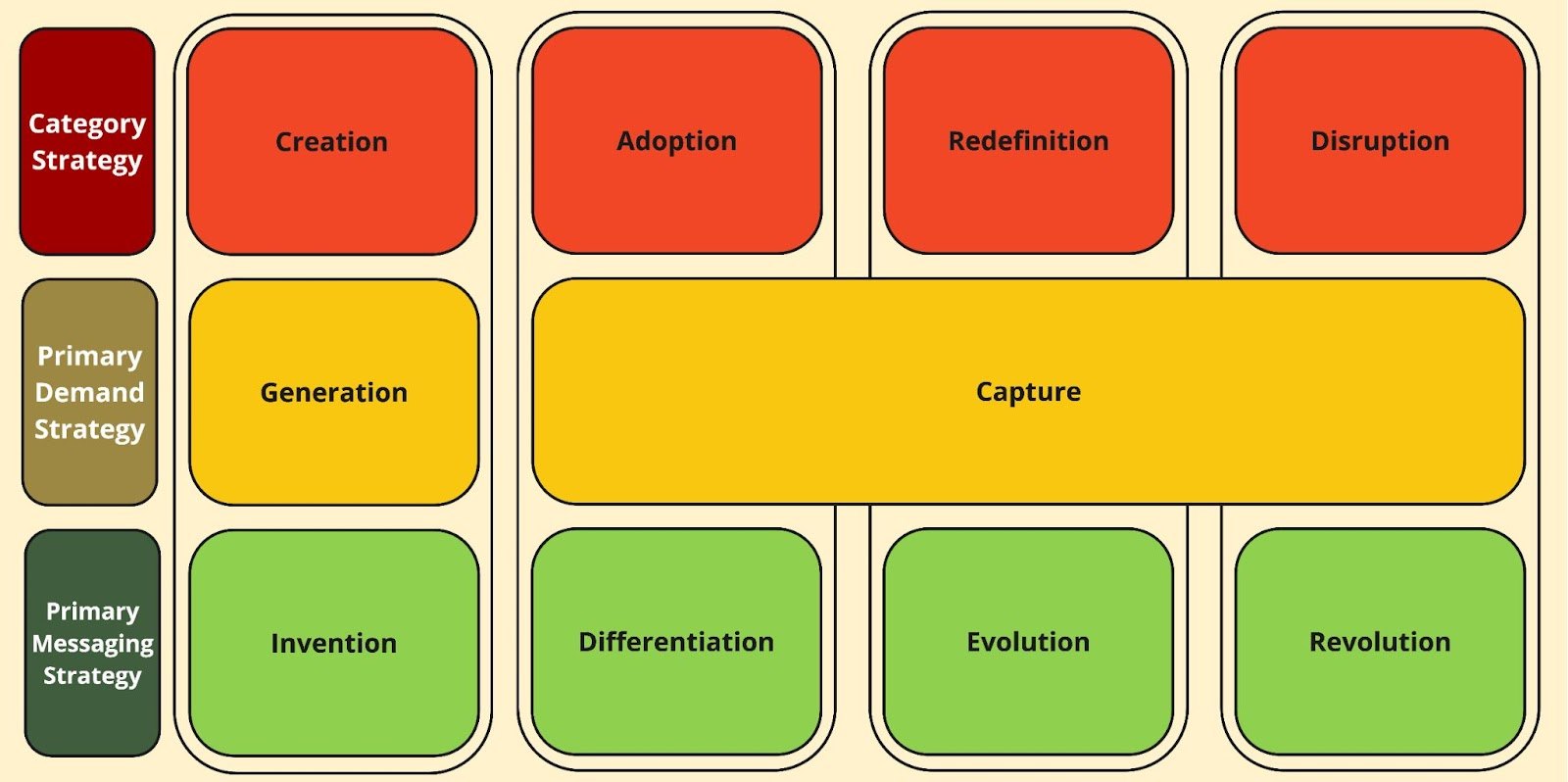
Each of the four Category Strategies has a paired Messaging Strategy. Let’s examine each of them in turn.
This is the strategy that LinkedIn posts would have you believe is the dream, and it’s certainly true that nailing Category Creation can deliver extraordinary value. However there are two obstacles:
For most start-ups the key to Category Creation is awakening the market - explaining to the world that the new Category exists. It may seem counterintuitive but this is way more important than promoting your brand or solution. We cannot capture demand if there is no demand out there to capture. What’s required is Demand Generation. The term demand generation is generally misused, what we really mean when we say this is demand capture - the gathering of relevant leads, acting with intent, responding to a CTA (Call To Action). Instead true demand gen is the spinning up of interest in the first place, and specifically alerting our ICP to the concept of the new Category.
So the strategy required here is one of Invention. We must explain to the world that something new and vital exists, we must explain why this new Category matters, and we must explain why the market should urgently care about it. This in turn requires a specific type of education - the delivery of earth shattering insight; because it’s insight that provokes change.
Joining or adopting a Category presents a very different challenge. This almost only happens when the Category is well established. The market understands the parameters, they know how to buy, what to look for; and crucially the Buyer has a budget line ready to fund a purchase. Our strategy here is classical Differentiation. What is it that positions us differently? Go back to your Value Stacks here, they were built to handle precisely this situation.
Succeeding with this strategy is about placing emphasis on your points of difference & providing the social proof that the prospects’ peer group have already bought into the way in which you answer their Critical Problem.
The previous two examples are pretty clear cut in that they deploy very different strategies to ignite very different market conditions. Conversely, the latter two are more complex - because:
Redefinition, like Creation, calls for market education; but this time to an already educated market. In other words Redefinition requires Re-education. This is an Evolution. The market must understand that this is not simply a case of choosing from a range of options to solve a problem, but that this is an “evolve or die” situation.
The hybrid is a mix therefore of Invention & Differentiation. We have created something kinda new but it stands on the shoulders of what went before. In other words, “same but different” - this is the nuance which requires careful language to communicate our message well.
Disruption has similarities with Redefinition, but in this case we are talking Revolution rather than evolution. We are not adding a new tower to our castle, we’re burning the castle down and building an entirely better one in its place. Our message to the market is that the current Category solutions are entirely broken and a new methodology is required.
Redefinition, however, is able to use the language of the Category. Disruption requires a new language. We need to show clear blue water between us and the competition so that rather than be regarded as “just” an alternative, we are perceived as the next generation. The punk rock to the prog rock that came before. In the same way that punk blasted into the consciousness of young people in 1976, Disruptive strategies tend to be aggressive, they need to break through the established paradigms by deploying the language of Revolution.
Written down like this the difference between the four Categories and their four related Messaging Strategies shouldn’t have to feel like rocket science. In my experience however, most start-ups haven’t given sufficient thought to this. The result? Muddled thinking and equally muddled Messaging. How many start-ups have you heard claiming to “disrupt a market”? Probably most that you talk to - but is that really what they’re doing?
It’s not important which of the four strategies you’re following. What’s important is to be crystal clear about your chosen strategy and ensure that your execution of the consequent Demand Approach & Messaging Strategy are deliberate and focused.
If you spent time working through the previous article you will have reached a conclusion on which of the four Category strategies is most appropriate for your business. If so, now have a go at the following:
Thanks for reading. If your messaging isn't landing and you're not sure why, email pete@revelesco.com and we'll talk it through.
See everything in Insights.
Tell us what is happening with your revenue, and talk it through with Pete or Emily.

[ Revenue insights ]
Concise and digestible. Revenue deep-dive analysis for B2B SaaS CEOs, Founders & Revenue leaders.


Design by V. Bakhal


