


Moats and defensibility point a company at its competitors, and a company distracted by its competitors is not focused on its customers. We help SaaS companies build Immunity instead: the ability to carry on past a competitor's attack without being affected. Immunity has five component strategies, Category, Criticality, Rarity, Parity and Matrimony, which sit at the heart of Diagnose & Align, the first phase of our Whole Revenue Strategy. Plotted on a five-point radargram, your strategy should always cover a greater area than your objective assessment of the competition.
You have probably heard the term, defensibility. You may even use it yourself. Maybe you have heard the term, moat - which is basically the same thing: the digging of a trench for protection. Those who deploy these terms tend to mean, how do we protect ourselves from our competitors who are doing the same thing as us, and thereby maintain our capacity for differentiation?
If these words encourage you to think through your differentiation then they are certainly not wasted, but I am not a fan. Both terms are giving serious please don’t hurt me vibes. If everyone is sitting back digging moats & building walls - who are we defending ourselves against? You guessed it, it’s the fast growing, innovative start-ups & scale-ups who are out there forging their own way forward. And surely we would prefer that to be us.
What are you defending against? Well, you're defending against your attacker. Who's your attacker? It's not your customer. It's your competitor. If you get distracted by your competitor, then you're not focusing on your customer. If you're not focusing on your customer, it's much harder to win.
Now this doesn't mean you don't take defensive actions, but you don't want to have a strategy of defensibility.
What's the inverse of defensibility? It's attack, I guess. And if you're going to attack your competitor - again, you're not focusing on your customer.
And so this doesn't mean don't attack. But it does mean - don't base your strategy on offense.
Instead, focus on Immunity. Immunity allows you to pass through the events you need to overcome without being affected. In other words, if you are attacked by a competitor, you carry on past them. Not unlike a vaccinated child in a room full of measles.
Think about a Formula 1 grand prix race. Sometimes you have to drive defensively, sometimes you have to drive offensively. But once you're out in front, you just gotta focus on taking those corners perfectly, on getting up to full speed on the straights. Of not being distracted, of being crystal clear about your mission and delivering on that mission; on finishing in first place. That is why Immunity is so important, but how do you develop it?
To develop Immunity requires a 5 component strategy. When added together, not only are we inoculated against anything nasty that’s out to attack us, but we are able to get out there in the world without a face-mask and set about winning.
The five component strategies are:
Let’s run through them briefly. Together they sit at the heart of Diagnose & Align, the first phase of Whole Revenue Strategy, where we define what makes your product critical and rare, and how you win your Category.
What the future of our market looks like.
What adds extraordinary value to achieve this future state, and is essential to solve our customers' problems in this new world.
What will be table stakes and in the meantime what we must do to neutralize our competition and stay ahead of expectations.
What we can do to embed ourselves so deeply with our ICP customers that they cannot imagine a future without us.
What we will do to ensure no-one solves the Critical Problem quite like we do. How we will develop & maintain a unique approach to solving the Problem.
You can think of the output as a 5 point radargram, the surface area of which must always be greater than your own objective assessment of your competition.
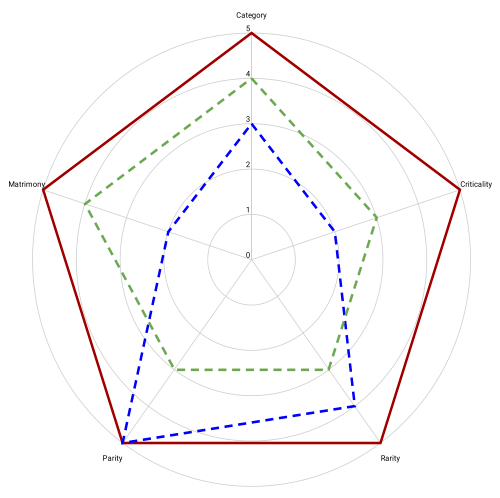
In this diagram we are the larger area, based on a score out of 5, and our two imaginary competitors are the dotted green & blue areas. You can clearly see that our strategy is more effective as we are winning in each of the 5 corners.
We dig into each of these in more detail in the Criticality & Rarity case study and the Parity article, both here in Insights.
Thanks for reading. If your numbers aren't where they need to be and you're not sure why, the Unit Economics Calculator sets them against 2026 benchmarks for companies your size and shows what to do next. Questions? Email pete@revelesco.com.
See everything in Insights.
Tell us what is happening with your revenue, and talk it through with Pete or Emily.

[ Revenue insights ]
Concise and digestible. Revenue deep-dive analysis for B2B SaaS CEOs, Founders & Revenue leaders.


Design by V. Bakhal


