



List every component that delivers value to customers (features, benefits, services and partnerships) under your three main buyer pains, and bundle them into Value Stacks. We score each stack out of 10, with up to five points for Criticality (how close to indispensable it is) and up to five for Rarity (how close to unique), then keep the top three, name them and plot them against competitors on a Criticality & Rarity Triangle (CaRT). Those three stacks define your category, and whether you create, adopt, redefine or disrupt it sets your primary marketing strategy.
Strategy is a term that affects people in peculiar ways. Some of us get drawn into endless chin stroking and never get anything meaningful done. Others think of it as an academic exercise to be avoided at all costs; while still others are intimidated by what they believe will be a herculean intellectual challenge.
Michael Porter, the godfather of modern business thinking, put its importance best:
“Strategy is about making choices, trade-offs; it’s about choosing to be different.”
Without the time spent on this critical topic we choose to be an also-ran.
This is the final installment of three articles covering the frameworks behind Diagnose & Align, the first phase of Whole Revenue Strategy. When we run through this live with clients, reaching the end of these 10 frameworks can be a magical moment as suddenly everything clicks into place. The time we've spent on strategic thinking finally reaches the pay off, putting us in a position where we can focus on precisely the right stuff to drive the business forward.
After this we move on to turning this firm foundation we have dug, into beautiful above-ground architecture; but before we do, let's turn to today’s summary. If at any point you want to dive deeper than this overview, just jump through on any one of the links below.
For these summaries I have split the 10 core frameworks into 3 distinct bundles. The first covers why the prospect must act immediately. The second defines the Value required to deliver on their Pain:
Today we are going to summarize Bundle #3: what is it about our product that is both Mission Critical and, just as crucially, differentiated in the way that it solves The Critical Problem?
In case you missed any of the detailed articles, here’s what we have covered so far:
If you are working through this as you receive these - I have good news - Bundle #3 is generally the step where things start to pull together and, not only begin to make sense, but start to show their practical application as part of your GTM planning.
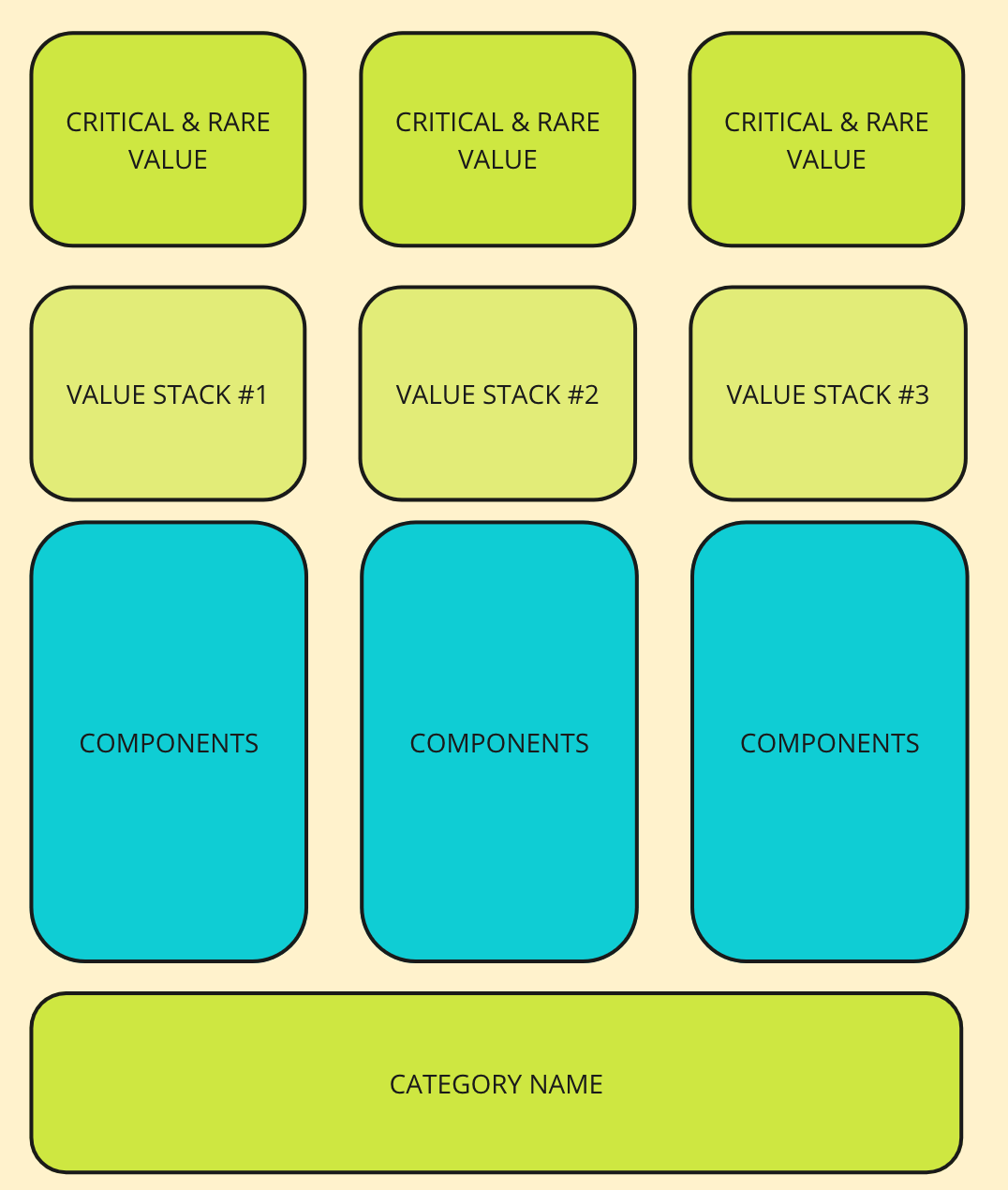
The starting point for Bundle #3 is to list out everything we do that delivers Value to our customers & prospects. Typically these Components can be split out into four different types:
Exhaustively group the Components beneath your three Pains. At this stage it is perfectly fine for Components to be duplicated and sit underneath more than one Pain.
Once you have a comprehensive list, bundle the Components together and label them. For example a bundle of Components that give insight into the past month might be named, “Insight & Future Planning”. There is no limit to the number of bundles you can have here.
These bundles are your infant Value Stacks. A Value Stack is a group of Components which when packaged together are:
a) Greater than the sum of their parts; and
b) Highly rare, indispensable, and defensible.
They deliver on a core and painful Need.
Score each Value Stack against two scales: Criticality, and Rarity. Experiment with moving Components around and note the effect on the scores. Each Stack will be scored out of 10 - with 5 points coming from Criticality, and 5 from Rarity.
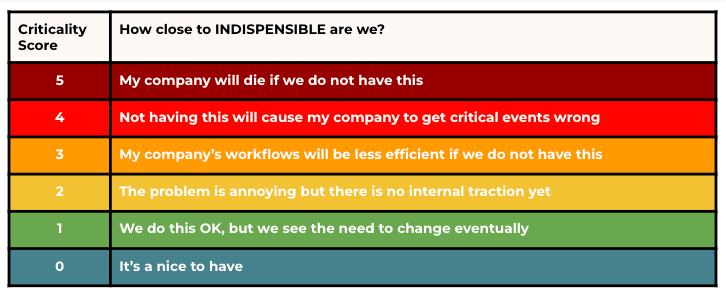
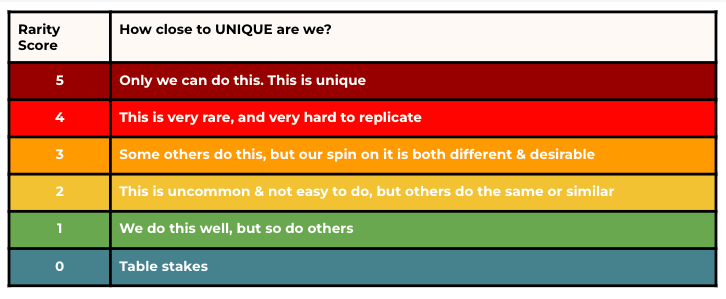
Debate the scores with your team and decide on your top three Value Stacks. Now break down the Components in detail on a spreadsheet and note whether your competitors (both direct & indirect) have this Component.
Decide on a label for each of the three Value Stacks - a name that would both land with customers & prospects, and accurately describe the Stack. This is very likely to be used later in our Messaging Pillars so choice of language is important (but not yet irreversible).
Build a spreadsheet that outlines all the features, services, benefits, and integrations which constitute each Value Stack.
Now score your competition against these same criteria. Plotting a Criticality & Rarity Triangle (CaRT) for both yourself and for each of the competitors (see below for example: two competitors are represented by the dashed triangles, with our business represented by the solid red triangle).
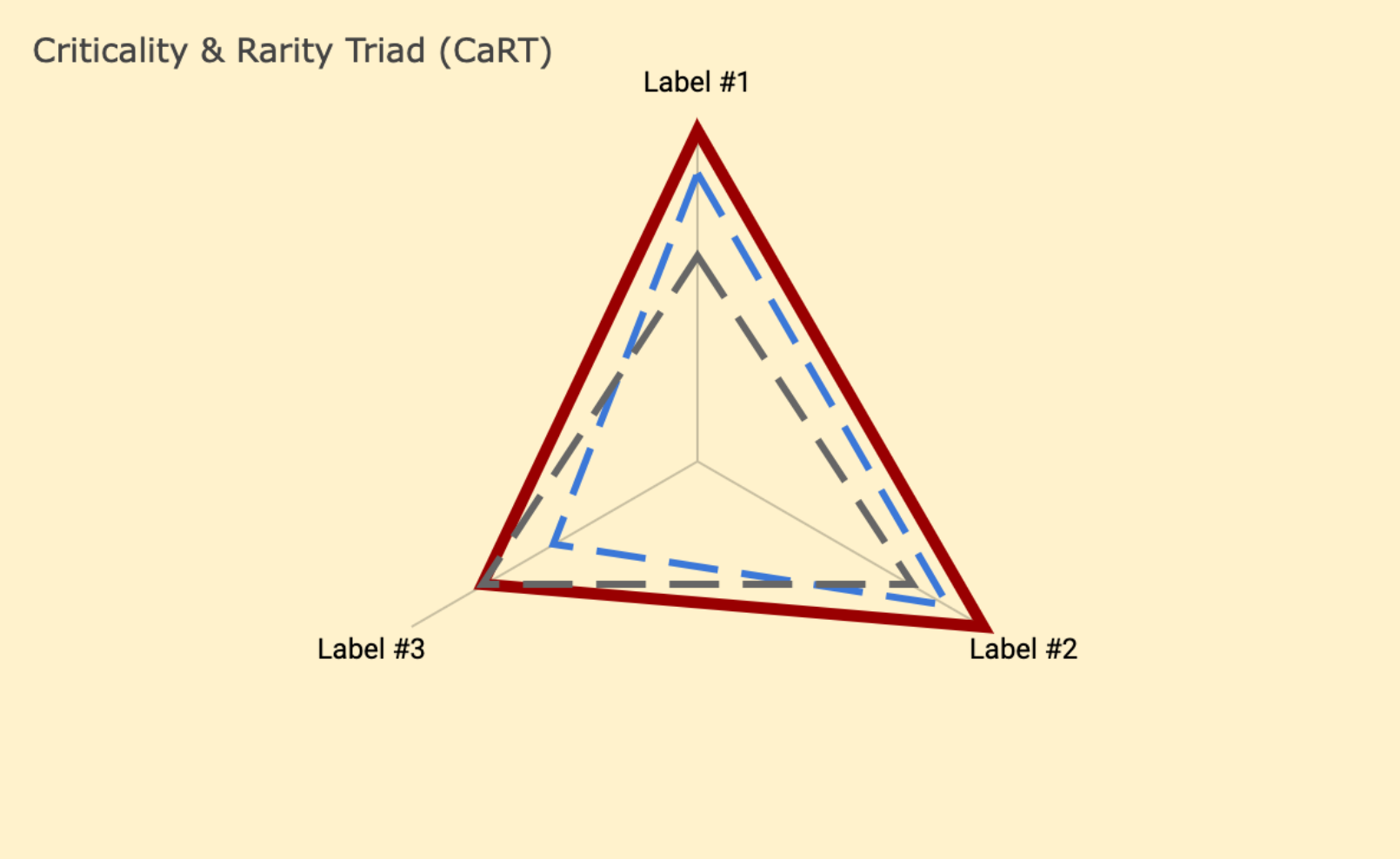
While we should never kid ourselves by scoring too highly it is important that the area of our triangle exceeds that of our competition. Don’t panic though if yours doesn't, or if it’s too close for comfort - this will inform your product roadmap; helping you to focus on product development to increase the distance between the vertices.
We can think of the three labeled Value Stacks as a guide to our prospect for their Criteria of Choice, the list of buying criteria which will shape their decision. In other words we are defining the Category. The question is, what kind of Category?
The four Category models
Part of the reason this is so important is that it points you in the direction of your primary marketing strategy. These can themselves be grouped into four principal types:
| Category Model | Description | Approach | Example (Category) |
|---|---|---|---|
| Create | We are the first to do this. This is a new Category. | We awakened the market to an entirely new Category. | OpenAI (Chat based language models) |
| Adopt | We are joining the Category. We will differentiate or/ and execute better. | We explain why our positioning is different to our competitors. | AWS (Cloud Platforms) |
| Redefine | Evolution of the current Category. This is a step-change, building on what went before. | We explain why we are the next generation. | Google (Search) |
| Disrupt | Revolution. The way things are done now is fundamentally wrong. We are ripping up the playbook & addressing the Category in an entirely new way. | We show that there is a better way to solve the current Pain. | Hook (Customer Success Software) |
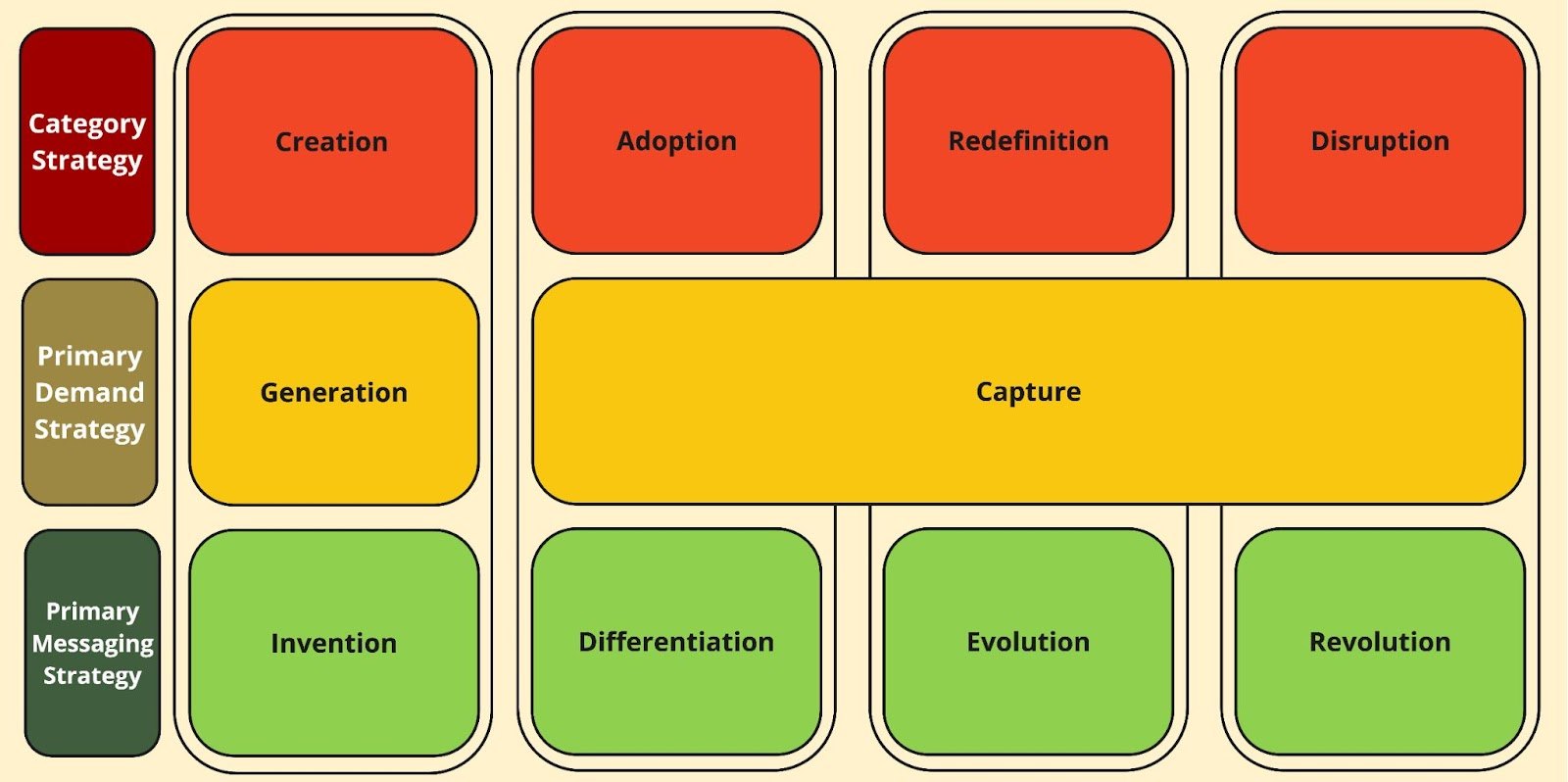
It is very fashionable to talk about creating a Category. However in my experience it is not actually all that common. If you conclude you're in the Creator group, that will have a huge impact on how you think about both marketing and messaging.
New Categories may have latent Demand i.e. there is a clear Pain to be solved. But they do not have active Demand. For example nobody wanted on-demand taxis until Uber invented the Category. Instead a Messaging Strategy of Invention must Awaken the market and therefore message the criticality of the Category, not of your brand or solution. We are endeavoring to Generate Demand.
The latter three Category Strategies have far less work to do on Demand Gen, they are all about Demand Capture. This means the demand already exists, and Casualties are actively seeking a solution, we need to be in the right place at the right time to Capture their attention and intent.
From here we move on from this foundational work to turning all of this into Messaging.
Thanks for reading. If your numbers aren't where they need to be and you're not sure why, the Unit Economics Calculator sets them against 2026 benchmarks for companies your size and shows what to do next. Questions? Email pete@revelesco.com.
See everything in Insights.
Tell us what is happening with your revenue, and talk it through with Pete or Emily.

[ Revenue insights ]
Concise and digestible. Revenue deep-dive analysis for B2B SaaS CEOs, Founders & Revenue leaders.


Design by V. Bakhal


